Showing posts with label Mexico - Culture. Show all posts

Saturday, November 03, 2007

Día de los Muertos

On 1st and 2nd November the Mexicans celebrate the Día de los Muertos (Day of the Dead). I know those days are celebrated as All Saints' Day and All Souls' Day in other countries (even in Germany) but there are some customs in Mexico which make it quite different or it even may appear strange to us. Well, I'm not an expert, I wasn't there on that day, I just can tell you a few things I was told.

One custom is to set the table also for your dead relatives that day. The believe is that the souls of the dead come back to our world for one day and setting the table for them is a way to show that they are still a part of the family.

In addition, many pastry shops produce Calaveras de Dulce, sugar sculls, which are given to each other as a present. Some even put the recipients name on the scull. When I first heard about it, I found it quite macabre but I was told it is a way to remind each other of the fact that all of us are mortal.


I found it surprising that the 2 days are not celebrated in silence or dolour. The Day of the Dead is a colourful folk festival. The streets are decorated with flowers and bizarre symbols of death.
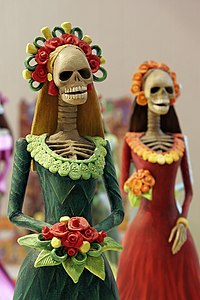

However, it should also be clear that customs vary from region to region. Most of them are of prehispanic origin and the Christian missionaries were unable to ban them. How is that saying? If you can't beat them, join them...

Wednesday, July 11, 2007

Fiesta Mexicana

Has anybody heard about the Australian Big Brother and how they caused an outcry among Mexicans living in Australia and also in Mexico? I think in Germany you could only read 5 lines about it in the newspapers; if at all. Here is what happened:

In the Australian Big-Brother house they had a competition called "Fiesta Mexicana". The first game was called "Sombreros musicales". All were dressed in traditional Spanish/Mexican cloths and wore heads of papier-mâché While the music played they had to run around a number of Mexican flags in the middle of the room. When the music stopped they had to grab one and those who didn't get any were eliminated.

Another game was called "Tabasco fiasco" where the competitors had to eat a number of different Mexican dishes.

But the game which the Mexicans didn't like at all was called "Frijoles saltarines" (jumping beans). The competitors where divided into two teams. One group had to throw balloons filled with a red liquid at a Mexican flag while the other tried to prevent that. That group which had the "driest" flag, won the game.

The last part of the competition was a quiz about Mexico. There were questions like "how the Mexican capital is called, the Mexican currency, when was the last soccer world championship in Mexico, how many inhabitants and from which country Mexico became independent. One competitor answered "United States"... and he got the point for that!!!

Wednesday, October 18, 2006

Looking back

After one month at home (one month but one day) I guess it's time to look back a bit at my time in Mexico. I don't look for a basket in the bathroom any more and driving according to rules is easier than I thought (it's really relaxing driving in Germany no matter how much traffic) but:
  • It's hard to be one time. I really don't expect any more that people are punctual.
  • You can't untwist German beer bottles.
  • Food I considered hot before isn't hot any more.
  • I forget to speak in a low voice sometimes... (The people in the cinema were quite annoyed!)
  • No trips on weekends any more (I'm still working on my thesis and looking for a job).
  • Sometimes I think people could be kinder.
  • I wonder about many people who complain about their situation.
  • I still confuse "y" and "z" on the keyboard.
That's what just came to my mind. I guess there is more... (to be continued)

Friday, September 08, 2006

Ahorita

Some of you may know that in Spanish you can form the belittlement (shame on me if it is the wrong word; looked in up on LEO) by adding -ito or -ita to a word (depending on whether it is male of female). Example: el dibujo (the drawing) - el dibujito (the little drawing); la casa (the house) - la casita (the little house)

But it is not only to "transform" nouns by this way. It also works with adverbs. One of my favourits and very often used in Mexico: ahorita! Ahora means now, so little now. Very helpful for example when your boss asks you to do something... to be honest it is very difficult to explain in English or German what it really means. My trial: not exactly now but soon (where soon can be between "in 5 minutes" and "during the next week"). It guess it is also a cultural thing;-)

When I told my colleagues at work that we don't rally have a word for this in German (except for maybe in Schwaben) they asked me: "But how do you say ahorita then?" And they hardly believed me when I explained that it is either now (jetzt, sofort) or soon (gleich).

Friday, September 01, 2006

Death

Maybe you have heard about Día de los Muertos. I think in English that is called "All Souls' Day" and it is on November 1st (or 2nd?), as a Catholic I should know!;-) The Mexicans celebrate that day in a very strange way. For example when they prepare dinner there are also chairs and plates for the dead. Or it is a custom to give each other a sugar skull with their name on it. I would call it a bit macabre but well...

Our landlord explained to us that death is present in Mexico anytime anyway. If you remember what I keep telling about Mexican traffic, I guess you will agree. But there are more occasions to prove this. As a German I would say that Mexicans don't care much about security: cars that only exist because of the rust, the foundry at the Volkswagen plant where hot iron is moved in open containers, zebra crossings on the motorway...

Wednesday, August 30, 2006

"Bueno"

Those who called me here in Mexico may have noticed that "bueno" is the way you answer the phone here. I guess everybody who is used to saying their name, find this a bit strange because how do you know who's talking.

Now you may say: "Well, I just can ask."And exactly that is the problem! It is considered inpolite to ask. Why? Because you didn't recognize the other person. I know, hard to understand but it's part of the Mexican culture. So they prefer pretending in case they don't know who is talking. I can imagine this already caused a lot of funny situations...

Saturday, August 26, 2006

Jobs

I wanted to publish a post about "jobs" already some time ago but I didn't have the right picture. Now I have, here is the post...

To be honest, I don't really know how you call somebody who polishes your shoes in English. The Spanish word is botanero and you can see one of them on the pic. They are quite common here and some time ago it was a notable job.


For me as a German it is still quite strange imagine having somebody polish your shoes. I would feel a bit bad because I don't want somebody "getting to his knees" in front of me.

But to be honest this is not the only service you get here and which seems a bit strange to me. There are people who wash your car. For 30 pesos (a bit more than 2 €) and many people tell them afterwards where they have to wash or polish again because their car doesn't shine enough.

Then, there are people on the carpark of the super market, for example, who "help" you getting into and out of your parking spot by blowing a whistle and making wild gestures. After your shopping they expect a little tip. And they are not there because Mexicans can't park (although...). Usually those people don't have a proper job and try to earn at least a little money by that. You should know something like a social system doesn't exist here although there are a few ways you get help from the state.

Something else which doesn't exist in Germany (and I guess the rest of Europe) any more: filling station attendants. Of course they expect a little tip, too.

There are people who don't do anything else but waving a red flag at the railroad crossing. To tell you, you can pass...

And the best (I saw it when I came to the internet café): People painting topes (humps to reduce your speed). Of course expecting a little tip for it when you pass.

Wednesday, July 19, 2006

Another "Wake up!"

Last weekend I went to Zacatlan. It's a nice small city about 3 hours by car from Puebla. On the pic you can see the nice view you have there. When we were at that place (where I took the picture), we asked ourselves if it wasn't possible to go down this valley. So we asked a woman in a shop who told us that it was possible and also told us the direction where we had to go. Because of our experience with Mexicans telling you where you have to go (see one of the previous posts), we also asked a policeman for the way. He told us that it was forbitten to go down there because it was so slippery.

Nonetheless, he went with us to the place where the path starts downwards. Additionally he went away and came back with to boys (about the age of 8) to guide us downwards for a coke each.

I guess that describes some more things in Mexico.

Wake up!

The other day, when I looked out of my window in the morning, I saw this:
You think that's the Mexican style of changing tyres? - No!
That's the Mexican style of stealing tyres over night.

To be honest I don't feel that save any more although they told us that we live in a quite save area. I guess "quite save" means "relatively save considering I'm in Mexico".

The "funny" thing is that usually it's not a problem to find your tyres or other parts of your car again. In most cases you can find them on a market in town (called Falluca) the other day. That means if you are quick enough before somebody else buys them. So what you can do is buying them back at that market. Proving someone that they stole them is almost impossible.

So I should say: Wake up! You are in Mexico!

Friday, July 14, 2006

Trapanovia

or: macho y hembra

Some time ago, I promised to write about Mexican men and women and their rolls. Or should I better say: how they behave in public?

As Mexico is a very catholic country, you can find the classical roles of men and women in society: he goes out to work, she stays at home to look for the children and the house. Although things are changing here as well, at least those who don't study marry and have children early.

What else? If something like that exists, the "typical" Mexican guy is someone between a macho and a caballero (gentleman). Opening the door for a woman and similar things are very common. At the same time you hardly find a Mexican who doesn't say that women can't drive and many more things I don't want to mention here. And how to describe the "typical" Mexican woman? According to Tiziano Ferro they all have a moustache;-) (I guess that was a great publicity gag. And it worked!). Well, without being mean I think I can say that there are more beautiful than intelligent Mexican girls/ women (Of course there are exceptions and one doesn't exclude the other).

Thursday, July 13, 2006

Some politics

Mexicans don't like it very much, when foreigners make comments about their politics. So I won't do that. But it should be allowed to write something about the elections that were helt the weekend before.

Honestly, for the presidential elections there were only two real candidates: Felipe Calderón and Manuel Obrador (or to be precise: Felipe De Jesus Calderón Hinojosa and Andrés Manuel Lopez Obrador). One candidate for the PAN (Partido Acción Nacional) and the other for the PRD (Partido de la Revolución Democrática) and other centre-left parties.

Before the elections Calderón was the favourite. Well, maybe just here in Puebla where there are a lot of foreign companies and the people are even more catholic than in the rest of the country. The actual result was quite a surprise for the people (here). 35.88% for Calderón compared to 35.31% for Obrador. It seems that although almost the whole (rich) North of Mexico voted for Calderón, Obrador has a lot of supporters in the (poor) South. While Calderón promised to create new jobs by reducing obstacles for (foreign) companies, Obrador's program is a more social one.

But if you think that was it: wrong, wrong, WRONG! Obrador claimed irregularities during the counting of the votes. Now the whole case will end in front of the Surpreme Court. Until September they have to investigate the whole thing but it seems that Calderón is to be the new president. He probably will succeed Vicente Fox who is president now.

BTW, Goerge W. Bush was one of the first who congratulated Calderón being the new president. How come...?;-)*

And don't forget there is still a vacabulary test waiting for you!

*This isn't Mexican politics so I can be a bit ironic.

Friday, July 07, 2006

Where the emperor has to go by foot...*

... he also has to use paper.

or: What to do with it afterwards?

Fabian wanted to hear more of this "every-day stuff". This post is dedicated especially to you, Fabian. :->


People used to what we could call "Western European standard" will be shocked by this information: In Mexico you are not allowed to throw the toilet paper into the toilet. Instead you have a wastepaper basket next to the toilet. This is because of the bad quality of Mexican drainage systems. They just would clog.

But to calm all of you who were shocked too much: At our house we throw the paper into the toilet. Hey, we all are Germans and our landlord never mentioned that it's not allowed.

Please don't forget the vocabulary test (see post July 01)!

*In German this is a nice expression to avoid the word "toilet".

Wednesday, June 21, 2006

Mexican "football"

Those who thought this was about the match of the seleción mexicana last Friday were wrong. Does the match need any comments? ;-)

My contribution to this topic during the world championship is about the ancient ballgame. (Maybe I'll also write about recent Mexican football but first let's see how far they get in that match).

The ancient ballgame is the world's first team-sport. In pre-Hispanic times it was played in several variations all over Mesoamerica.

The ball was made of rubber and wighted several kilos. The players were only allowed to touch it with shoulders, elbows, hips, thights and knees. Those parts of the body were protected with leather protectors. However, when the game was over the players were bleeding everywhere because of the weight of the ball.

The ball was not allowed to touch the ground but the walls on each side of the field (sometimes they were sloping) could be used. The aim of the game varied depending on the region where it was played. In Xochicalco - where I was last weekend - the ball had to be thrown through a kind of rings on the walls (see picture: the two things on the ground used to be attached to the wall) while in other regions the aim was to move the ball to the other side of the field (similar to modern football).


In most cases the game had a religious meaning. Sometimes the ball represents the sun which has to make its way on the horizon and is not allowed to crash (fall on the ground). In other parts it was related to the fertilization of the ground somehow representing sun and rain.

After the game players were often sacrificed. And now the surprise: not the losers but the winners (at least that's the conclusion of some sources). It was an honour for the best team to be sacreficed because they believed that by this they gained a "better life" after death while "normal people" would have a "miserable next life". As our tour guide in El Tajin said: "Modern people will never really understand this thinking."

Further information

Wednesday, June 14, 2006

How to say... (without words)?

Today let me introduce the "strange" world of Mexican gestures to you. In many situations gestures are used. Sometimes it's because you can't understand each other like in the disco or between two drivers. And sometimes I guess Mexicans are just to lazy to open their mouth.

To say "yes", you open and close your index finger while the rest of the hand is closed. I don't know how to describe this in a better way therefore I add some pictures.


If you want to say "no", you show the back of your index finger and move your hand from one side to the other while the rest of the fingers is closed.


To say "thank you", you make this gesture. It took me some time to get used to that. Before, I had known this gesture only from German drivers where it definitly doesn't mean "thanks";-)


You make this gesture in order to say "sorry". I guess it represents a person falling to their knees.


And this means "gay". It is used by Mexicans, for example, when they talk about Ronaldinho (this really happened in a bar in Papantla).


Special note to Mr. Ronaldinho's lawyer: I didn't say Ronaldinho is gay.

Wednesday, June 07, 2006

666

Don't worry. I haven't become a satanist. The title of today's post is related to the belief of many Mexicans that today something very bad would happen. Like an earthquake or the breakout of a volcano (see post May 25). And that's just because of the date (06.06.2006) and the relation of the number with the devil. By the way, does anybody know where that comes from?
It's true that many Mexicans took this date very serious. I guess they have a somewhat special relation to supernatural things (and to death as well). Some people at Volkswagen didn't like the idea of having a meeting today because they thought it would have a bad outcome. And in similar ways quite a lot of people believed in some kind of effect.

As far as I can see nothing happened. And if there really was something at 06:06:06 in the morning: I still slept at that time of the day (or better NIGHT).

Tuesday, May 16, 2006

Finding your way

Finding your way is not always easy in Mexico. In most cases you have to ask someone. After some time I found out that it is better to ask several people because it increases the possibility that one person gives you the right answer. In most cases Mexicans don't tell you when they have no idea where the place is you are asking for. It is considered as inpolite to give a "negative" answer. Difficult to understand for Europeans, I agree. A very common answer if you ask for the way, is todo derecho which means something like "Just right this way." With what I wrote above you can imagine how often it is REALLY "Just right this way."


What helps a bit finding your way is that most Mexican cities are structured systematically: like a chessboard. Most cities have a central square called zócalo. The streets leading direcly to the zócalo have a real name like "5 de Mayo" or "Avenida Hidalgo". The streets which lead to one of those streets to the west are called ponientes, those to the east orientes, to the north nortes and to the south sures. So far, so good. You still understand the system;-)? Of course not all streets to the north can be called nortes etc. Therefore they also have numbers. The start with the small numbers from the zócalo but not like 1, 2, 3... In one direction are the even numbers and in the other the odd numbers. For example the nortes that are in the west of the city have the numbers 2, 4, 6... and those in the east 3, 5, 7... (the 1 never exists).

Wednesday, May 10, 2006

Buses

During the last few days I used the buses several times. Guess what? The bus drivers drive even more crazy than the car drivers. Maybe it's because it's not their buses. Or they think they know the streets. But I think more probable they just think they are the best drivers on earth;-)
What may appear stange to most Europeans is that there are no timetables for the bus! It is just there when it arrives;-) And if you ask people on the bus where you have to get off, you always get a different answer. But to be honest it's not that easy. If you ask in a nice way, you can get off almost anywhere. Nonetheless, I took the wrong bus once and couldn't get off where I wanted.

Saturday, April 29, 2006

Driving

Yes, it's true. Most Mexicans drive like crazy. And if you want to get somewhere, you have to adapt to their way of driving. At Volkswagen they have courses for those Germans who have been working here for 3 or 4 years and are about to return: the repatriats (some know the expression). You know what they teach them? Well, besides other things that in Germany there are rules for driving!
But honestly driving here is not as bad as it sounds. You get used to it very quickly. You just have to take care a bit more and think for the driver next to you or in front of to you.
During my first week here only one of the interns and one of the trainees had an accident...;-)